
Curling sport
Rules of the game and number of players
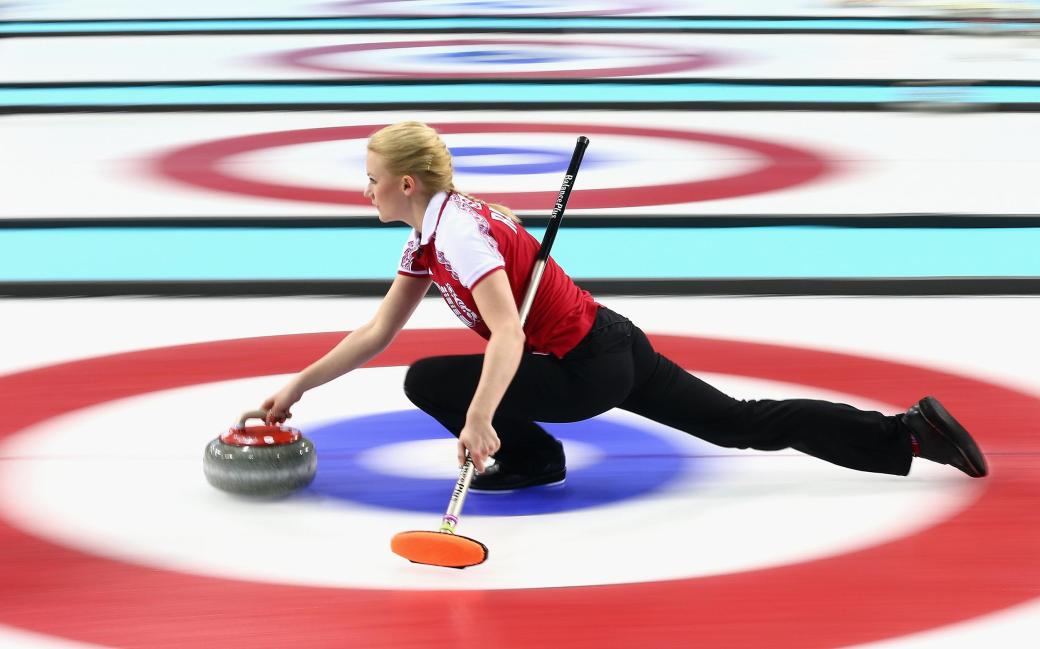
Curling is a sport in which players slide stones on a sheet of ice towards a target area which is segmented into four concentric circles. It is related to bowls, boules and shuffleboard Two teams, each with four players, take turns sliding heavy, polished granite stones, also called rocks, across the ice curling sheet towards the house, a circular target marked on the ice. Each team has eight stones. The purpose is to accumulate the highest score for a game; points are scored for the stones resting closest to the centre of the house at the conclusion of each end, which is completed when both teams have thrown all of their stones. A game usually consists of eight or ten ends.
The curler can induce a curved path by causing the stone to slowly turn as it slides, and the path of the rock may be further influenced by two sweepers with brooms who accompany it as it slides down the sheet, using the brooms to alter the state of the ice in front of the stone. A great deal of strategy and teamwork go into choosing the ideal path and placement of a stone for each situation, and the skills of the curlers determine how close to the desired result the stone will achieve. This gives curling its nickname of « chess on ice »
Origins and history
Curling was invented in medieval Scotland, with the first written reference to a contest using stones on ice coming from the records of Paisley Abbey Renfrewshire, in February 1541. Two paintings, « Winter Landscape with a Bird trap » and « The Hunters in the Snow » (both dated 1565) by Pieter Bruegel the Elder depict Flemish peasants curling—Scotland and the Low Countries had strong trading and cultural links during this period, which is also evident in the history of golf.
The word curling first appears in print in 1620 in Perth, Scotland, in the preface and the verses of a poem by Henry Adamson . The game was (and still is, in Scotland and Scottish-settled regions like southern New Zealand) also known as « the roaring game » because of the sound the stones make while traveling over the pebble (droplets of water applied to the playing surface). The verbal noun curling is formed from the Scots (and English) verb curl, which describes the motion of the stone.
In the early history of curling, the playing stones were simply flat-bottomed river stones, which were of inconsistent size, shape and smoothness. Unlike today, the thrower had little control over the ‘curl’ or velocity and relied more on luck than on precision, skill and strategy.
In Darvel, East Ayrshire, the weavers relaxed by playing curling matches using the heavy stone weights from the looms’ warp beams, fitted with a detachable handle for the purpose. Many a wife would keep her husband’s brass curling stone handle on the mantelpiece, brightly polished until the next time it was needed. Central Canadian curlers often used ‘irons’ rather than stones until the early 1900s, Canada is the only country known to have done so, while others experimented with wood or ice-filled tins.
Outdoor curling was very popular in Scotland between the 16th and 19th centuries because the climate provided good ice conditions every winter. Scotland is home to the international governing body for curling, the World Curling Federation, Perth, which originated as a committee of the Royal Caledonian Curling club , the mother club of curling.
Today, the game is most firmly established in Canada , having been taken there by Scottish emigrants . The Royal Montreal Curling Club , the oldest established sports club still active in North America , was established in 1807. The first curling club in the Unites States was established in 1830, and the game was introduced to Switzerland and Sweden before the end of the 19th century, also by Scots. Today, curling is played all over Europe and has spread to Brazil, Japan, Australia, New Zealand, China, and Korea.
The first world championship for curling was limited to men and was known as the Scotch Cup held in Falkirk and Edinburgh Scotland, in 1959. The first world title was won by the Canadian team from regina, sakatchewan, skipped by Ernie Richardson. Curling was one of the first sports that were popular with women and girls.
Curling equipement
To play curling every player need :
*Curling stone
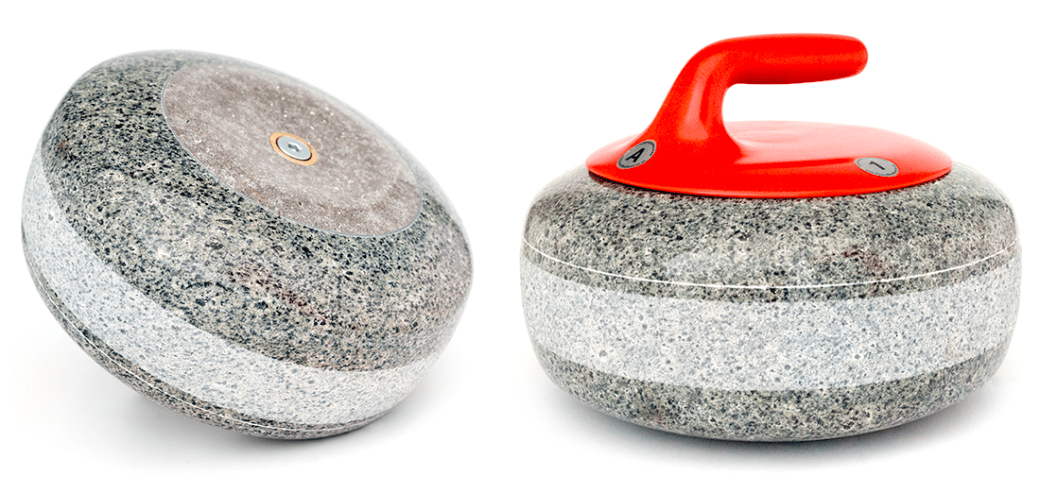
The curling stone (also sometimes called a rock in North America) is made of granite and is specified by the World Curling Federation, which requires a weight between 38 and 44 pounds (17.24 and 19.96 kg), a maximum circumference of 36 inches (914.4 mm) and a minimum height of 4.5 inches (114.3 mm).[16] The only part of the stone in contact with the ice is the running surface, a narrow, flat annulus or ring, 0.25 to 0.50 inches (6.4 to 12.7 mm) wide and about 5 inches (130 mm) in diameter; the sides of the stone bulge convex down to the ring and the inside of the ring is hollowed concave to clear the ice. This concave bottom was first proposed by J. S. Russell of Toronto, Ontario, Canada sometime after 1870, and was subsequently adopted by Scottish stone manufacturer Andrew Kay.
*Curling broom
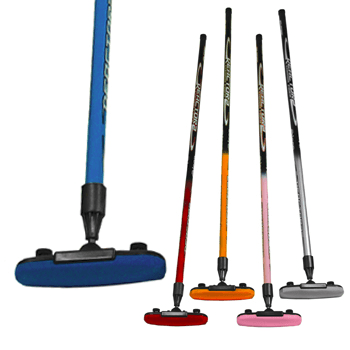 The curling broom, or brush, is used to sweep the ice surface in the path of the stone, and is also often used as a balancing aid during delivery of the stone.
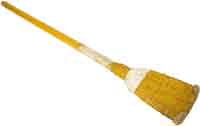
Prior to the 1950s, most curling brooms were made of corn strands and were similar to household brooms of the day. In 1958, Fern Marchessault of Montreal inverted the corn straw in the centre of the broom. This style of corn broom was referred to as the Blackjack.
 Artificial brooms made from man-made fabrics, rather than corn, such as the Rink Rat, also became common later during this time period. Prior to the late sixties, Scottish curling brushes were used primarily by some of the Scots, as well as by recreational and elderly curlers as a substitute for corn brooms, since the technique was easier to learn. In the late sixties, competitive curlers from Calgary, such as John Mayer, Bruce Stewart, and, later, the world junior championship teams skipped by Paul Gowsell, proved that the curling brush could be just as (or more) effective without all the blisters common to corn broom use. During that time period, there was much debate in competitive curling circles as to which sweeping device was more effective: brush or broom. Eventually, the brush won out with the majority of curlers making the switch to the less costly and more efficient brush. Today, brushes have replaced traditional corn brooms at every level of curling; it is rare now to see a curler using a corn broom on a regular basis.
Curling brushes may have fabric, hog hair, or horsehair heads. Modern curling brush handles are usually hollow tubes made of fibreglass or carbon fibre instead of a solid length of wooden dowel . These hollow tube handles are lighter and stronger than wooden handles, allowing faster sweeping and also enabling more downward force to be applied to the broom head with reduced shaft flex. New, « directional fabric » brooms, which players are worried will alter the fundamentals of the sport by reducing the level skill required, have been accused of giving players an unfair advantage. The new brooms were temporarily banned by and Curling canada for the 2015-2016 season. The new brooms « isolate the friction caused by brushing only where the running surface of the rock has contact with ice––on top of the pebble––with little resistance », which makes sweepers have unprecedented control over the direction the stone goes.
*Shoes
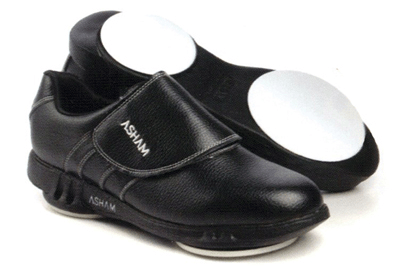 Curling shoes are similar to ordinary athletic shoes except that they have dissimilar soles; the slider shoe (usually known as a « slider ») is designed for the sliding foot and the « gripper shoe » (usually known as a gripper) for the hack foot.
The slider is designed to slide and typically has a Teflon sole. It is worn by the thrower during delivery from the hack and by sweepers or the skip to glide down the ice when sweeping or otherwise traveling down the sheet quickly. Stainless steel was once common for slider soles, and « red brick » sliders with lateral blocks of PVC on the sole are also available. Most shoes have a full-sole sliding surface, but some shoes have a sliding surface covering only the outline of the shoe and other enhancements with the full-sole slider. Some shoes have small disc sliders covering the front and heel portions or only the front portion of the foot, which allow more flexibility in the sliding foot for curlers playing with tuck deliveries. When a player is not throwing, the player’s slider shoe can be temporarily rendered non-slippery by using a slip-on gripper. Ordinary athletic shoes may be converted to sliders by using a step-on or slip-on Teflon slider or by applying electrical or gaffer tape directly to the sole or over a piece of cardboard. This arrangement often suits casual or beginning players.
The gripper is worn by the thrower on the hack foot during delivery and is designed to grip the ice. It may have a normal athletic shoe sole or a special layer of rubbery material applied to the sole of a thickness to match the sliding shoe. The toe of the hack foot shoe may also have a rubberised coating on the top surface or a flap that hangs over the toe to reduce wear on the top of the shoe as it drags on the ice behind the thrower.
Other equipment
Other types of equipment include:
Curling pants, made to be stretchy to accommodate the curling delivery.
A stopwatch to time the stones over a fixed distance to calculate their speed. Stopwatches can be attached either to clothing or the broom.
Curling gloves and mittens, to keep the hands warm and improve grip on the broom.
Athletes play curling
Curling is a mixed sport. There are 4 category of teams .
the first category is the womens.
The name of this teams is Fleming.It is composed of 4members :
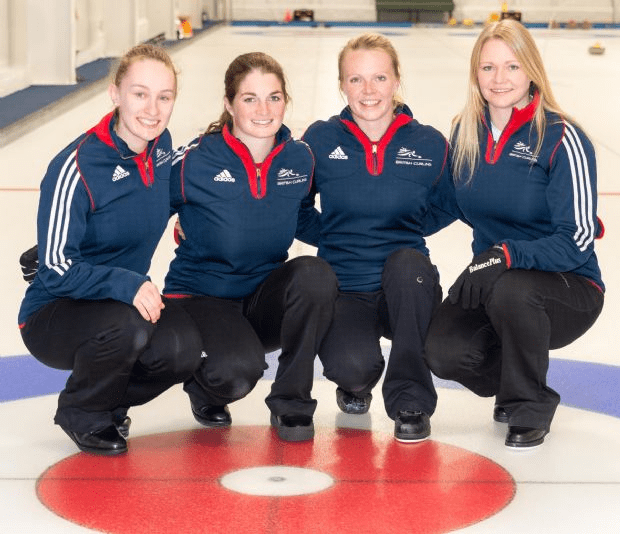
Hannah Fleming
Jennifer Dodds
Vicky Wright
Alice Spence
The second category is the mans :

The name of this man is David Murdoch. David Murdoch is a British curator born on April 17, 1978 in Dumfries, Scotland. He won the silver medal in the men’s tournament at the 2014 Winter Olympics in Sochi, Russia.
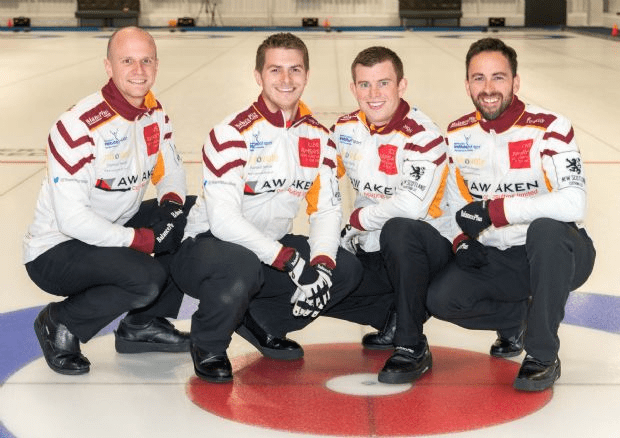
The name of his Team is Murdoch. His teams is composed od 4 members.t is composed of
David Murdoch
Greg Drummond
Scott Andrews
Michael Goodfellow
The third category is wheelchair
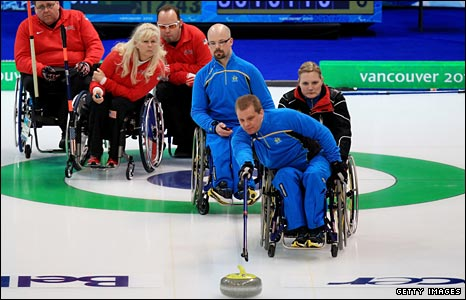
The last category is mixed double
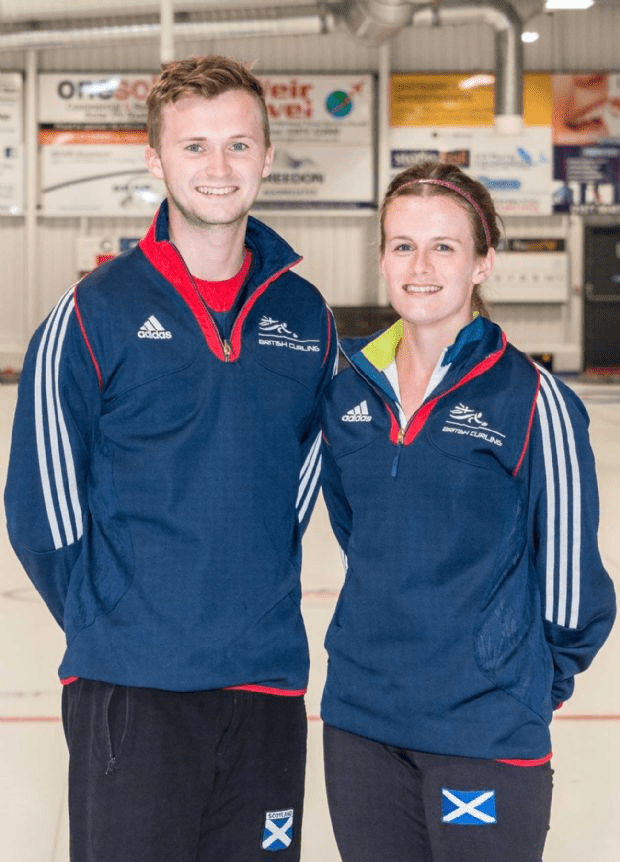
The names of these two athletes are Bruce Mouat and Gina Aitken.






 Typically British sports